The first thing I remember about New York is not a recording studio. It was snow.
I had come from the Queensland Conservatorium of Music, and before that from a childhood on the equator, where the seasons were only ever variations of warmth. I arrived in New Jersey as winter was settling in, to intern with the Grammy-winning engineer Ken Lewis. Ken and his wife had opened their home to me, and he kept a studio inside it, so that work and life folded into the same rooms. I had crossed an ocean and a hemisphere to be there, and I had never in my life seen real snow.
It came one afternoon while a client was over, working on a track. The snow began quietly, the way important things often do, and then it thickened until the front yard disappeared beneath it. Someone noticed me at the window. Knowing I had never seen anything like it, everyone simply stopped. We left the session where it was and went outside into the cold.
We built a small snowman. We made angels in the snow, lying back and moving our arms as though we were learning to fly. Someone threw a snowball and then everyone was throwing them. The cold was a shock, a clean and total surprise, and the silence that came with the snow was unlike any silence I had known. The whole world had been muffled, made soft and strange. I understood, standing there with snow melting into my collar, that I had entered a country whose language I did not yet speak.
The days had a rhythm, and the rhythm began around ten in the morning. Before Ken could mix, someone had to prepare the ground beneath the music. That was my work. I organised sessions, labelled tracks so that nothing would be lost or confused, cleaned audio, edited out the small imperfections, and assembled the stems so that everything was ready by the time the real work began. It was invisible work. Done well, no one would ever know it had been done at all.
I worked alongside Brent, Ken's full-time assistant, and together we would prepare for the long overnight sessions that took us into the city, into Sony Music Studios, Battery Studios, and the other rooms where New York made its records. There is a particular exhaustion to those nights, and a particular exhilaration. The city outside would empty and quiet while inside the studio the work went on, hour after hour, until the windows began to grey with morning.
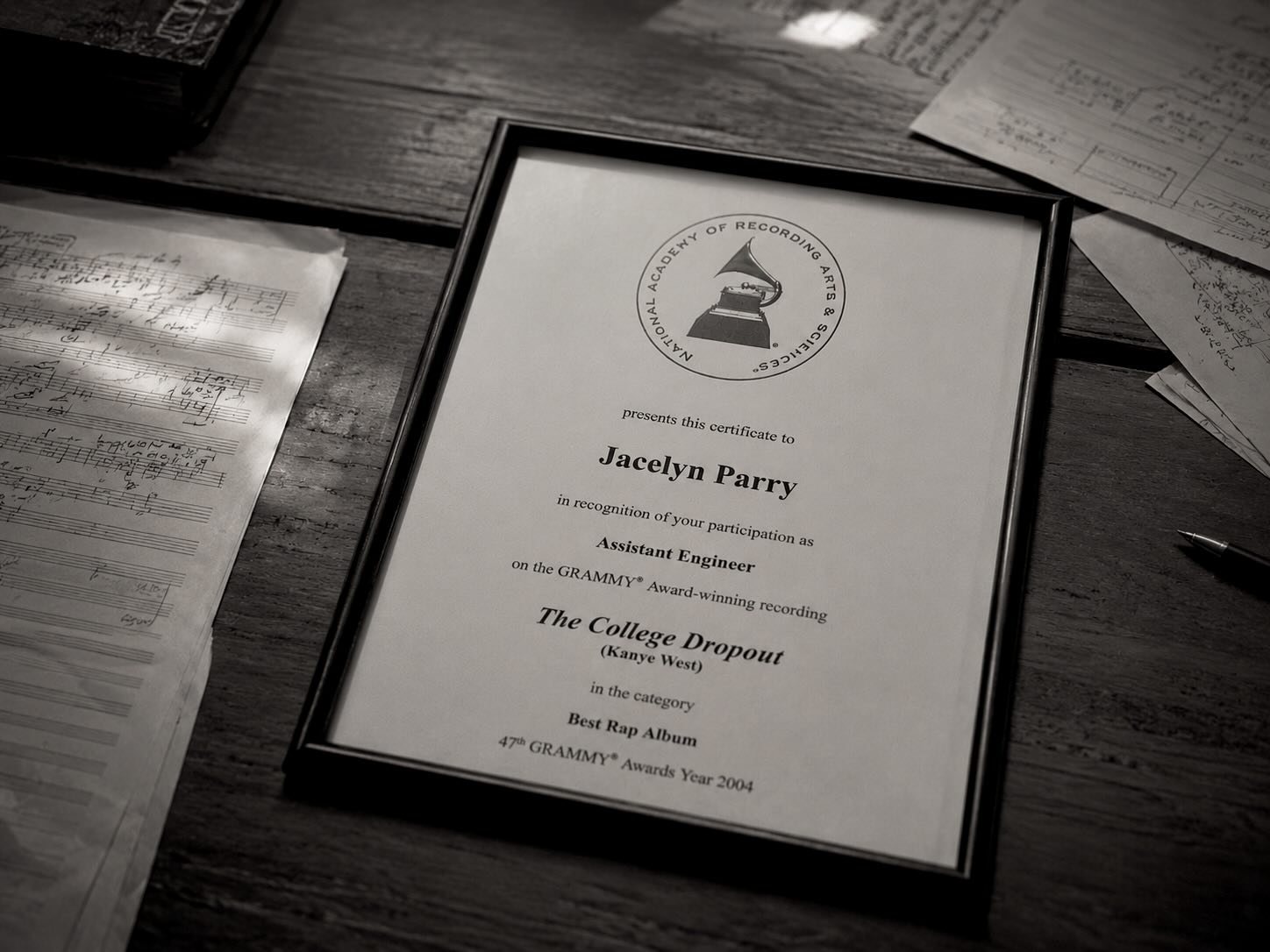
It was during this period that I worked on Kanye West's The College Dropout. Later, a certificate arrived recognising my participation as an assistant engineer on the recording. I have kept it. It sits among my papers, quiet, a little formal, easy to overlook.
I want to be honest about what the certificate is and is not. It is not the centre of this story. It is an artifact, a piece of paper that names a fact. What mattered was never the recognition. What mattered was the thousand small acts of attention the recognition stands in for: the tracks labelled correctly, the noise removed so gently that the music never noticed, the long care taken over things no listener would ever consciously hear.
There were encounters in those studios that I might have made into stories, and have chosen not to. Wyclef Jean passing through a session and asking me if I had any beats for him to check-out. Just Blaze at a console. One night Lou Reed was recording, and his bassist leaned out and invited me into the room to watch. I never went. I do not entirely know why. These moments drift through my memory now like passing constellations, luminous and far away, part of the sky of that time rather than events I lived at the centre of. I was young, and I was learning, and I did not yet understand which doors were worth walking through.
To understand what that apprenticeship was, you have to understand the kitchens and the hallways. They were full of us, young musicians and engineers, gifted and hungry and waiting. Cigarette smoke hung in the air of those rooms. Everyone was hoping that one of the veteran engineers would come through a door and call their name, that a night's work would open into a career, that talent and proximity would finally resolve into a chance.
It took me some time to see my own position clearly. I had a place to stay, a mentor who trusted me, and meaningful work that was mine to do. Many of the people in those hallways had none of these things. They had only their gift and their waiting. Slowly I understood that I was among the fortunate ones, and that fortune of this kind is largely invisible to the person holding it until they look around and notice who is standing beside them, and how long they have been standing there.
On the days when I was alone at home, I would play the white baby grand piano that stood by the large window, and the snow would fall on the other side of the glass while I played. There is a kind of solitude that is not loneliness, and those afternoons held it. The piano, the window, the snow, the quiet. I was learning something then too, though it did not feel like learning. It felt like being restored.
Other times I would take the train into Manhattan to hear jazz at Birdland or the Blue Note. As an intern I could not afford many concerts, so these evenings were rare and precious. And it was around this time that Tony Byrne came to visit.
Tony was a bluesman from Brisbane, a friend from home. I had assisted him in a major studio there, where he mixed for bands, and now he had come to New York partly, I think, to check on me, to see if I was all right. He was very tall, and he travelled with almost nothing, a small backpack holding two black T-shirts and two pairs of black jeans. His hair was long and white, his beard greying, his eyes deep and compassionate and unhurried. He always reminded me of Gandalf, not as a joke but as a feeling: the sense that he carried some calm and ancient wisdom through the chaos of the city, that he had walked long roads and was not frightened by anything he found on them. An angel, I sometimes thought. A guardian who had arrived at exactly the right time.
Tony knew people in the music world, and so doors opened that would otherwise have stayed closed to someone on an intern's wages. He took me to concerts I could never have afforded, and he did it without ceremony, simply inviting me along as though it were the most natural thing in the world. I was so grateful to him. My Gandalf, my bluesman angel, who understood that a young person far from home needs more than work. She needs someone to make sure she is still living.
It was there that music stopped being something I engineered, and became something I lived through the body.
One of the most memorable of those nights was Sergio Mendes at the Blue Note. The music was extraordinary, the musicians luminous. Afterwards we went to greet Sergio, and then, together with the Brazilian percussionists from the band, we went somewhere else, an underground club with no sign and no name.
When the doors opened, everything glowed. The room was lit red, and bodies were turning back to back on a crowded floor to the sound of a live Nuyorican band. I never learned who they were. It was too loud to ask, and in any case names would have added nothing to what was happening in that room. They sounded a little like Groove Collective folded into Masters at Work, that particular New York alchemy of Latin roots and dance-floor gravity. The energy was infectious, physical, total.
It was there, on that packed red floor, that strangers taught me to dance the Forró. Brazilian, they told me, as we took turns gliding across the room, and I gave myself over to the steps without understanding them, learning through the body what no console could teach. For all the nights I had spent making music exact, this was music that could not be made exact, that existed only in the doing, only in the moment it was danced. I think I had needed that more than I knew.
New York was a place where everyone was talented. It sounds like an exaggeration, and it is not. Nearly every person I met was extraordinarily gifted at something, and every conversation carried the charge of that giftedness, as though the whole city were a single instrument tuned to a pitch just above ordinary life.
And yet it was hard to make friends. People moved in tribes there, and to stay in New York you had to find your tribe. Without one the city became an alienating place, all immense glass buildings stretching for miles of grey on grids of concrete, traffic and jarring sirens blaring on every corner. It was expensive. To survive you had to learn the hustle, to turn every encounter to some advantage, to carry an ambition that soared higher than the Empire State Building.
But when you did get to work on something, some project with these other gifted people, it always felt as though you were part of something great that was happening, some current running just beneath the surface of the city. The people of New York made you feel that way. Opportunity was always waiting around the corner, and everyone was eager to invest themselves in something, anything, that might turn their talent into something greater than themselves.
And then, slowly, with each passing day, I understood that it was not a place for me. It was exhilarating, and it was exhausting, and it was carrying me away from the very thing I had come to music for in the first place. I began to feel that ambition was becoming louder than beauty. The work was extraordinary. But somewhere in the noise of it, I was losing the quiet reason I had begun.
What I carried away from New York was not the certificate, nor the famous studios, nor the famous musicians who passed through my nights like distant stars. It was a way of listening. Attention to detail. Respect for silence. Care for the invisible work that allows music to exist at all, the labour no listener ever hears but every listener depends upon.
I never really left New York. Parts of it still live in the way I hear a bass line, the way I prepare a recording, the way I listen before I begin to play. But the city was leading me toward another question. The next chapter would begin across the Atlantic, in a place connected to my family long before I understood why I was being drawn there.
Related Entries